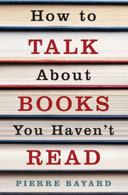
There is a certain irony in
writing about a book that explicitly encourages its reader to form opinions
about texts with which he is only slightly (if at all) familiar. Indeed, it
would only seem fitting to write a review of How to Talk About Books You Haven’t Read without actually reading it.
For me, the major contribution
of Pierre Bayard’s How to Talk About
Books You Haven’t Read is its implicit commentary on a sort social hermeneutic
which takes into account the interpretive ecology which surrounds a text. As a result,
Bayard argues that we should be less focused on the negative consequences of falsely
recollecting past texts than with the potentially generative value of creatively
(mis)remembering them.
It is through this sort of
social hermeneutics I believe Bayard displays great acumen in parsing out his
distinction between reading and close reading. At the surface, Bayard appears
to argue for a level of reading that is anything but “close,” but his
brilliance lies in the fact that his method argues otherwise.
The book’s initial chapters
are formed around specific types of “non-read” books (e.g. skimmed, forgotten,
etc).
As a way into each type, Bayard recalls a specific literary scene from a
prominent work of literature in which this situation has been depicted. For
example, in his chapter “Books You Don’t Know,” Bayard presents defense for not
reading books at all by way of a Robert Musil character who adamantly refuses
to read any of the books within his vast library for fear of losing sight of the
whole collection and how the books relate to one another.
Through these specific
examples, Bayard is able to circumvent an explicit defense of close reading by
putting it on display within its proper environment: writing. By enacting the
contradiction of his thesis (skimming or non-reading), Bayard defends close,
critical approaches to texts without watering down his argument with gratuitous
qualifications which would certainly distract from the books playful tone
.
Depending on your degree of
affinity with Bayard’s ideas about non-reading, it is either an illuminating
and candid portrait of our relationship to past texts, or an indulgent
apologetic for poor scholarship.


No comments:
Post a Comment