Tuesday, August 26, 2014

Kathleen Blake Yancey and Networked Composition Pedagogy

As all of the authors in this week’s readings have shown (and which is evident in the slashed nature of its title), the field of rhetoric/composition/writing studies is inseparable from its struggle over a variety of epistemological, administrative, and pedagogical issues. As a result, RCWS is rather unique in its disciplinary status as a field which, in many ways, can be defined by the way in it continually seeks to (re)define itself as field. In other words, the circuitous, messy, and revisionary nature of the disciplinary debates surrounding the role of RCWS are constitutively bound to its focus on writing, a phenomenon which RCWS itself was integral in exposing as circuitous, messy, and revisionary.

Although I aligned at certain points with all of the pedagogies I encountered this week, I most identify with the claims put forth by Kathleen Blake Yancey in “Made Not Only in Words: Composition in a New Key.” I appreciated Yancey’s approach to composition in this article because she considers the current culture of writing (the proliferation of multimodal/social/networked communication) as a vital “moment” with which composition should partner rather than a divergence that should be analyzed and resisted.

Yancey articulates a composition pedagogy grounded in a notion of writing which considers circulation within a network of other writers and readers as one of the constitutive characteristics of writing in the 21st century (300). Yancey also claims that composition pedagogies that engage with writing communities outside of the classroom not only encourage a focused rhetorical purpose in student writing but potentially supply students with a readership that can critically engage with their writing in a manner beyond that of the teacher (310-11). For Yancey, writing is a deictic activity, and its meaning is inseparable from the localized, rhetorical contexts through which its effects play out.

Finally, I appreciated Yancey’s article because it strikes a balance between critical and instrumental pedagogies that I find lacking in a pedagogy like Berlin’s. Because Berlin’s pedagogy emphasizes the liberation of student consciousness, it subordinates the instrumental (teaching students how to communicate in a variety of cultural discourses) to the critical (resistance to hegemonic cultural discourses) in ways that our counterproductive to both (“Rhetoric and Ideology,” 490). Yancey, on the other hand, seems to operate under a notion (which is one that I agree with) that although composition pedagogies should encourage students to grapple with the ways in which power and ideology are produced in a society through a variety of discursive modes and contexts, this critical subjectivity is more effectively evoked by pedagogies that encourage students to become co-producers of those very discourses (imagistic, textual, auditory, etc.) rather than passive consumers who analytically resist it.

Friday, August 22, 2014

Hacking Writing Studies with Gilbert Simondon

In her introduction to the concept of technogenesis in How We Think, Hayles departs from her focus on digital media and travels back to the mid-twentieth century, building her analysis off of the theories of the French mechanologist Gilbert Simondon who categorized technology into three interrelated, but distinct, areas: technical elements, technical individuals, and technical ensembles.

To give the most basic definitions of these terms, a technical element is a part of the object, a technical individual is the unity achieved through the collection of all of the parts, and a technical ensemble is a technology necessary to create the object. Thus, in the case of an ax, a technical element could be its handle, the technical individual would the ax itself, and its technical ensemble could be the tool used to sharpen it or even the craftsmen using the sharpening tool.

For Simondon, innovation occurs when technical elements (parts of the object) are placed into new contexts, thus initiating the creation of new technical individuals that are either more efficient iterations of the technical individual from which it originated or an entirely new technical individual. Hayles describes the former move to efficiency (which Simondon refers to as “concretization”) as the integration of “conflicting requirements into multipurpose solutions that enfold them together into intrinsic and necessary circular causalities” (88). In other words, the objects themselves become subordinated in a Heideggerian sense to the various goals for which they were created.  

As technology become more concrete and complex, there is a corresponding decrease in the visibility of technical elements (parts) and an increase in technical individuals (wholes). Although complex technology is not bad in itself, it undoubtedly requires an increased amount of time in order to understand how it operates, and not only that, it also forecloses productive engagements with other technical elements due to the increased specificity and integration of its parts. This increase in technological complexity is also compounded by burdensome patent laws that restrict innovation by perpetuating the fear of technological plagiarism.

Although subcultures devoted to promoting technologies which emphasize part interconnectivity and exchangeability (technical elements) are beginning to emerge in the form of hacker/maker spaces in cities and universities across the country, the dominance of global capitalism has largely determined the conditions of technological change in its continued emphasis on the creation of discrete (and profitable) technical individuals.

In his chapter “Rethinking Repair,” Steven Jackson locates the material consequences of this increased emphasis on technical individuals over technical elements in Apple’s release of the 2012 MacBook Pro, a device which was widely criticized for using parts that couldn’t be recycled and sticking to a design aesthetic that made parts too difficult (if not impossible) to replace (Jackson, 235). The aesthetic and functional appeal of Apple-esque technology (minimal, integrated, and intuitive) not only propagates an ideology of technological illiteracy (thus stifling innovation), it also leads to unsustainable models of technological production.  

Bridging off the technical taxonomy provide by Simondon and my brief analysis of technological innovation, I want to take what might seem at first to be a strange digression to the field of writing studies as a way of exploring how conceptualizing writing as a series of technical elements rather than isolated technical individuals can generate the kind of complex ecological approaches to the study of writing that Sid Dobrin describes in Postcomposition.

Technologies of Writing
There is theoretical potential for writing studies within Simondon’s concepts of technical elements, technical individuals, and concretization. What happens when we blur the borders between these terms?  Or are they already blurred within their application to technology? Although one could definitely make the claim that an ax head could be both a technical individual and a technical element, the important idea (at least for composition theory) is that these definitions are applied relationally rather than ontologically. In other words, its function as an element (part of an ax) or individual (a technical object in itself) is determined by its role within a particular system rather than by the limited possibilities that might be prescribed upon it.
Hayles describes this contextual determinacy of technics as “materiality” which she writes “is unlike physicality in being an emergent property. It cannot be specified in advance, as though it existed ontologically as a discrete entity” (91).

However, when looking at writing as a technology, there is greater fluidity between technical elements and technical individuals, determined largely by the degree to which the writing is deployed and perceived in a specific context. For me, it seems that writing is often assumed first as a technical individual. Although we are in a supposedly post-structuralist era of textual theory, even the most poorly structured piece of writing is typically approached as such (a structure). Thus, the default conception of a text appears to be fairly generous. A piece of writing works unless it is proven to be broken. Similar to Derrida’s claims about the purpose of deconstruction, the point of composition theory is not to tear throw a wrench in a functional system but merely to show that it was never functional in the first place.

However, I don’t want to preach the salvation of Derridean deconstruction for the future of writing studies. What I do want to do is think about how shifting our conception of writing and reading from technical individuals to technical elements can initiate innovative and individuated approaches to the production of writing similar to the way that shifting our relationship to technology can result in greater experimentation with previously separate technical elements.

Similar to the parts of a laptop, there needs to be an increased emphasis on the interchangeability of the parts used to make a piece of writing. Instead of viewing writing (especially technical writing) as an organic form of discourse that emerges naturally from the writing subject, compositionists should develop open source, collaborative networks of technical (elements of) writing that encourage the kind of processual thinking that composition theory has been championing for decades.
In viewing writing as a series of technical elements, the field of composition can also begin to re-conceptualize its approach to plagiarism which too often ignores theoretical critiques of textual originality. Composition traditionally assumes that by allowing students to intentionally plagiarize they may not develop themselves as original writers capable of producing original texts. However, these is little proof that remixing text necessarily leads to a decrease in originality. On the contrary, many scholars of rhetoric and new media, such as Collin Gifford Brooke, view originality itself as undergoing an definitional shift with the advent of new media and the proliferation of instant access to large amounts of networked information.

In Brooke’s estimation, originality is no longer the ability to individualistically produce ideas within text (which Brooke argues falls prey to the presence/absence binary criticized heavily by Hayles in How we Became Posthuman) but rather the ability to collect and synthesize information produced “originally” elsewhere (a move which aligns with Hayles’ claim that pattern/randomness is the pivotal binary of the twenty first century).

The problem is not that we ask students to build something before we ask them to repair it, the problem is that we are asking students to build technical elements (the paragraph, the sentence, the word) while at the same time building technical individuals (the essay, the research paper, the synthesis essay). This is the most difficult part of writing: the element and the individual coevolve and co-terminate (sometimes simultaneously) for writer and reader alike.


But what if teaching writing foregrounded pattern identification over content production, or, in other words, emphasized technical elements rather than technical individuals? Instead of teaching writing through the capitalist imperative of ownership (i.e. patents), or any other political ideology for that matter, we need to teach writing as an ecological system which reacts to (and acts upon) those who engage with its complexity.  

Tracing Complex Bio-Ideologies with N. Katherine Hayles and Byron Hawk

I recently finished two books by two incredible writers/thinkers: How We Think: Digital Media and Contemporary Technogensis by N. Katherine Hayles and A Counter-History of Composition: Toward Methodologies of Complexity by Byron Hawk. Hayles and Hawk, although they are writing for slightly different fields, nonetheless converge at crucial points related to the exigency of mapping the bio-ideological constitution of posthuman subjectivities. Although Hayles work (with which I am more familiar) is valuable for its typically impressive ability to synthesize various theoretical and empirical approaches to digital media, I ultimately found the implications of Hawk’s analysis more compelling due to what I saw as a greater emphasis on bio-ideological mapping in order to actively produce constellations of subjectivity rather than mapping bio-ideologies in order to consume and/or resist them.

In her most theoretical chapter, “Tech-TOC: Complex Temporalities and Contemporary Technogenesis,” Hayles foregrounds her methodology in a cartographic rhetoric, writing that she aims to “explore the coordinated epigenetic dynamic between humans and technics” (85). Throughout the chapter, she collates snippets of various thinkers working in the philosophy and sociology of technology, such as Mark Hansen, Bernard Steigler, and Bruno Latour, arguing that technology is the manifestation of a “complex temporality” which she defines most intriguingly as “temporary coalescences in fields of conflicting and cooperating forces” (86). In this move, Hayles collapses the constitutive distinction between human and non-human entities, a distinction which she challenges in greater detail in How we Became Posthuman. Hayles argues that in the same way that a technical object is a synchronic constellation of “conflicting and cooperating forces” of socio-cultural desires, so too is human subjectivity. Although not as pertinent to my uses here, Hayles concludes her chapter with an illuminating analysis of the interactive electronic novel TOC, illuminating its critique of the effects of computer technology on human perceptions of time.

Where I tend to depart from Hayles is in her move to what I see as an overly reductive model concerning the influence of technology on human cognition. Her central binary is conscious/non-conscious cognition, with external factors of one’s environment such as technology and language providing the majority of non-conscious forces upon one’s cognitive state.  Although the neurological and psychological research she draws from is compelling, it seems to set up a unidirectional flow of forces from exterior forces to interior unconscious that subordinates the role of human agency in meaningfully intervening in this process.
Essentially, Hayles fails to consider how our non-conscious states are also influenced by our conscious states which are then fed back into the non-conscious (both exterior and interior) realm. Although she uses the term “reciprocal causality” throughout this chapter, this term is primarily confined to the intertwined relationship between humans, technology, and society. However, the two cognitive states she prescribed (conscious/non-conscious) are also interrelated to such an extent that it seems pointless to privilege the influence of external factors in determining one (non-conscious) more than the other (conscious).

Referencing her previous work on the attentional shift taking place from deep to hyper attention in younger generations, Hayles focuses in on the neurological effects of digital media and begins to veer into the realm of bio-technological determinism (99-102). Much like her initial article in ADE, Hayles privileges the neurological principles of “synaptogenesis” and “neuroplasticity” in effecting epigenetic changes in cognitive structures which then presumably lead to changes in other psychological processes. As is increasingly becoming the case in reductive models of human consciousness, the complexity of thought is subordinated to neurology.

Reacting to these external factors of posthuman consciousness formation, Hayles posits her technologically assisted solution by distinguishing it from neuro-philosopher Catherine Malabou’s implications in The New Unconscious. Malabou’s guiding claim is that the structure of human consciousness is beginning to mirror the structure of global capitalism. Because Malabou does not offer a technologically assisted method for resisting the neurological effects of one’s economic system, Hayles denigrates Malabou’s implicit assumption that neural plasticity can be monitored by nothing more than conscious awareness of the plasticity of unconscious influence.

Conversely, Hayles proposes that we utilize the same technologies that are affecting these neuropsychological changes to map their influence on cognitive functioning. She writes, “Another possibility, implicit in the concept of technogenesis, is to use digital media to intervene in the cycles of continuous reciprocal causality so that one is not simply passively responding to the pressures of accelerating information flow but using for different ends the very technologies applying the pressure” (102). Hayles briefly mentions two such mapping technologies: the sociometer, created by Alex Petland of MIT, which can sense subtle, unconscious movements such as influence, mimicry, activity, and consistency; and the somameter, a device developed by Mark Hansen at Duke which reports unconscious biological states to the user.
Hayles interprets all of these technological influences through a focus on attention. Building off her thesis in a previous article concerning the value of both hyper and deep attention, Hayles mostly wants to map the effects of technics on human consciousness in order to redirect our collective cognitive trajectory away from complete hyper attention and towards a more balanced emphasis on both hyper and deep attention.
However, I don’t think I am as quick to part with Malabou’s ideological resistance in favor of Hayles’ technophilic cartography. Although technologically assisted mapping may be valuable to a certain extent, it should not be privileged over conceptual entities such as ideological and political structures.

From Mapping as Resistance to Mapping as Invention
Byron Hawk makes a compelling case in A Counter-History of Composition: Toward Methodologies of Complexity for a renewed emphasis on the role of invention within composition pedagogies. I say “pedagogies” because I agree with Hawk that one of the fundamental difficulties of teaching writing is creating a generalizable link from local, classroom specific techniques, ideas, and assignments to a global theory or method. Indeed, with his emphasis on Ulmerean heuretics in his pedagogy chapter, Hawk explicitly supports a move away from “a pedagogy” of generalizable methods of invention and towards “pedagogies” of individuated methods particular to each student’s context: “the goal should be to learn about one’s place in the circuitry and to invent a method particular to these circuits” (248). For Hawk, mapping the complexity and formation of posthuman subjectivity only works by providing individuals (students in this case) with the technology necessary to create their own map rather than showing them the place they should end up (Berlin’s citizen-rhetors) and then hoping they eventually get there.

Although his complex-vitalist theory of composition pedagogy relies heavily on experimental compositionists such as Gregory Ulmer and Cynthia Haynes, I believe that his primary theoretical underpinning rests on a binary separating general/particular (global/local) which he builds off of Deleuze and Guattari’s concept of the molar/molecular. Hawk privileges the molecular for its emphasis on the local linkages, or Deluze-Gauttarian “desiring-machines,” which intersect and create a multiplicity of subjectivities within the same individual. Although Hawk doesn’t draw from The Three Ecologies in his book, I think this quote from Guattari conveys the concept: “it is important not to homogenize various levels of practice or to make connections between them under some transcendental supervision, but instead to engage them in processes of heterogenesis” (34, Guattari). The translator goes on to define Guattari’s notion of heterogeneity as “an expression of desire, of a becoming that is always in the process of adapting, transforming and modifying itself in relation to its environment… However much organizations attempt to homogenize desire, something always escapes or leaks out (the ‘line of flight’)” (95).

Guattari’s move from homogeneity to heterogeneity is connected to the pivotal concept of the body-without-organs. Organs organ-ize and prescribe the limits of action for a particular entity, whether that be an individual or group of individuals. Theorists attempting to map the complexity of posthuman subjectivity have located these organs in various contexts, sometimes including, as is the case with Hayles, actual organs (the brain). For Hawk, although biology is included as an important factor, the predominant organ-ization of student subjectivity for him is ideological.


Thus, drawing on experimental composition pedagogies such as Ulmer’s mystory genre, Hawk proposes an approach to bio-ideological mapping as a series of pedagogical tools designed to generate a multiplicity of potential subjectivities rather than as a means for preventing undesirable states of future subjectivity (such as Hayles’ hyper attention).

Database and Narrative with Lev Manovich

In The Language of New Media Lev Manovich operates within a limited notion of “narrative” that prevents him from recognizing the semantic potential present within the term to which he opposes it: the database.  Setting up the contrast between these two terms (database/narrative), Manovich writes:

As a cultural form, the database represents the world as a list of items, and it refuses to order this list. In contrast, a narrative creates a cause-and-effect trajectory of seemingly unordered items (events). Therefore, database and narrative are natural enemies. Competing for the same territory of human culture, each claims an exclusive right to make meaning out of the world. (225, emphasis added)

Although Manovich defines a database early in this chapter as “a structured collection of data,” he quickly differentiates it from the kind of linear, cause-effect structure of narrative, which he describes as simply one method among many others for “accessing data” (220). Manovich then condenses these various methods of accessing databases into the more general term “interface.” As an example of interface, he describes a database of images being represented by a page of hyperlinked thumbnails which provide the user with a structured interface to access the underlying data.

For Manovich, the database and interface are mutually constitutive elements of new media. The interface relies upon the database for its content, and the database relies upon the interface for providing the user access to its content. In locating this symbiotic relationship between database and interface, Manovich argues that the ability to construct alternate interfaces over the same database (what he terms “variability”) “places the opposition between database and narrative in a new light” (227). Indeed, it is not so much that alternate interfaces create alternate narratives, but that even within a single interface there exist “multiple trajectories” that a user could potentially construct. In other words, the narrative that an interface actualizes in relation to its database is highly contingent upon the actions of the user.

However, Manovich’s limited notion of narrative begins to reveal its frailty when he describes the inability of random access (the user contingent narrative described above) to generate a narrative structuration of database content. He writes, “if the user simply accesses different elements, one after another, in a usually random order, there is no reason to assume that these elements will form a narrative at all” (228). And again when he writes that “a database can support a narrative, but there is nothing in the logic of the medium itself that would foster its generation” (228). In short, a database holds the potential for narrative but does not in itself create this narrative.

However, I think Manovich is neglecting the degree to which a meaningful narrative is dependent upon the user’s interpretation. Although there may appear to be limitations contingent upon the database material itself, this limitation is predominantly subjective. The onus of determining what constitutes a narrative falls upon the user/reader.  

In this way, one can see how the “variability” which Manovich claims occurs at the level of interface also occurs at the level of the user, and even more so if we consider that Manovich’s notion of narrative stems from Mieke Bal’s general definition of “ ‘a series of connected events caused or experienced by  actors’” (228).

For Manovich it is the role of the author, or programmer, to “control the semantics of the elements and the logic of their connection so that the resulting object will meet the criteria of narrative” (228). Thus, Manovich neglects the database’s potential for generating alternative narratives in favor of the author’s pre-“programmed” interpretation of what constitutes one.

Manovich’s most prescient analysis of the relationship between database and narrative occurs in his inversion of the materiality of the paradigmatic and syntagmatic functions of new media. Bridging off of the semiological definitions of the two terms provided Barthes and Saussure, Manovich describes how the syntagmatic is the actual set of words that are strung together in a materialized sentence or phase, and the paradigmatic dimension is the set of potential words for which they could be exchanged. As Manovich puts it, “syntagm is explicit and paradigm is implicit; one is real and the other is imagined” (230).

New media, however, construct opposite functions of paradigm and syntagm by inverting their underlying material structures:  “database (paradigm) is given material existence, while narrative (the syntagm) is dematerialized” (231). In a database, the range of possible elements (paradigm) with which one could construct a narrative (syntagm) is the only stable, material reality of a new media object. As each syntagmatic construction appears and disappears, the underlying material with which it was formed remains consistent for the user. “On the material level, a narrative is just a set of links; the elements themselves remain stored in the database. Thus narrative is virtual while the database exists materially” (231). 

However, Manovich’s linguistic correlation is complicated once again by the nominal difference he sets up between narrative and interface. Undoubtedly, the majority of database elements that a user is likely to encounter in new media have already been constructed within a navigable, user friendly interface which not only accounts for possible trajectories but oftentimes explicitly encourages them. In addition, as new media databases increase in quantity they often decrease the amount of possible trajectories. Consider for example the innovations made to video databases such as Netflix and YouTube. The massive amount of elements stored in each database necessitates an efficient interface that corresponds to the particularities of individual users. They offer suggested videos and even (as in the case of Netflix) entire genres based off your viewing history. Thus, for Manovich, I would propose a new formula for new media: as the paradigmatic increases in quantity, the syntagmatic increases in prominence.


As another example, consider the many changes made to Facebook’s news feed option which many users initially decried because it was “too cluttered with excess information” (Wikipedia). In a 2006 blog titled “Calm down. Breathe. We hear you,” Mark Zuckerberg defended the increasing syntagmatization of the user’s Facebook experience writing that “information people used to dig for on a daily basis” is now “nicely reorganized and summarized.” The exploding popularity of Facebook combined with the proliferation of smartphone technology resulted in an overwhelming database of information that necessitated a more limiting and narrativized interface. 

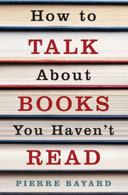
Review: How to Talk About Books You Haven't Read

There is a certain irony in writing about a book that explicitly encourages its reader to form opinions about texts with which he is only slightly (if at all) familiar. Indeed, it would only seem fitting to write a review of How to Talk About Books You Haven’t Read without actually reading it.

For me, the major contribution of Pierre Bayard’s How to Talk About Books You Haven’t Read is its implicit commentary on a sort social hermeneutic which takes into account the interpretive ecology which surrounds a text. As a result, Bayard argues that we should be less focused on the negative consequences of falsely recollecting past texts than with the potentially generative value of creatively (mis)remembering them.

It is through this sort of social hermeneutics I believe Bayard displays great acumen in parsing out his distinction between reading and close reading. At the surface, Bayard appears to argue for a level of reading that is anything but “close,” but his brilliance lies in the fact that his method argues otherwise.
The book’s initial chapters are formed around specific types of “non-read” books (e.g. skimmed, forgotten, etc). 

As a way into each type, Bayard recalls a specific literary scene from a prominent work of literature in which this situation has been depicted. For example, in his chapter “Books You Don’t Know,” Bayard presents defense for not reading books at all by way of a Robert Musil character who adamantly refuses to read any of the books within his vast library for fear of losing sight of the whole collection and how the books relate to one another.

Through these specific examples, Bayard is able to circumvent an explicit defense of close reading by putting it on display within its proper environment: writing. By enacting the contradiction of his thesis (skimming or non-reading), Bayard defends close, critical approaches to texts without watering down his argument with gratuitous qualifications which would certainly distract from the books playful tone
.

Depending on your degree of affinity with Bayard’s ideas about non-reading, it is either an illuminating and candid portrait of our relationship to past texts, or an indulgent apologetic for poor scholarship. 

Tuesday, August 12, 2014

Interpretive Force in Melville's Bartelby, The Scrivener

Herman Meliville's Bartleby, The Scrivener is a fascinating little story that is concerned with what I term the paralysis of interpretation. If we look at the story as an analogy for the act of interpretation where Bartelby is a stubborn text and the narrator an overzealous critic, it seems that Melville is saying that there is no true method for interpreting a text because a text will always “prefer” to remain just as it is in its present state.

The relationship between Bartleby and the unnamed narrator couldn’t be simpler: Bartleby, a former employee for the narrator, has decided to abstain from any kind of work, yet refuses to leave the office, remaining in an almost permanent stasis throughout the greater part of the story. The narrator, on the other hand, is less persistent in his actions. Perhaps it is because the reader is granted such unfettered access to his thoughts (it is written in first person), but the narrator is as inconsistent in his interpretations of Bartelby’s actions as Bartelby is consistent in acting them out. The narrator best describes the crux of their relationship when he says near the end of the story, after many futile attempts to prompt Bartleby to alternate courses of action, that “[e]ither you must do something or something must be done to you” (29). In short, Bartleby must evince a preferred path for future actions (text speaking for itself) or the narrator must force Bartleby onto a course of action that runs counter to his “preference.” In both scenarios, the prospect of acquiescing to Bartebly’s preference is not entertained as a permanent and final option.

The irony of their relationship is that the narrator is no different from Bartleby in his indecisiveness. He refuses to enforce what seems to be the only clear course of action for ridding himself of the scrivener: calling the authorities to remove him. In fact, upon learning of the subsequent landlords decision to do just that, the narrator says that he “almost approved” for “it seemed the only plan” (31). For the later landlord, the decision was simple. Ask Bartleby to alter his actions, and if he does not, force the actions to alter Bartleby. The landlord responds to the paralysis of interpreting Bartleby by simply rejecting the prospect of interpretation altogether. 

Writing Technology with Derrida

For me, Derrida’s analysis in Paper Machine of computer mediated writing drifts along the border between refreshingly succinct and disappointingly narrow. Beginning with the former characterization, I found his final analysis of the (then) burgeoning shift from traditional, book oriented publishing to online publications to be quite equitable in its resistance to a totalizing evaluation of the publishing industry. Derrida deftly recognizes that although the move to online publishing breaks down some of the distribution barriers erected by traditional publishers, it simultaneously (and inevitably) opens the door to the much maligned glut of narrow minded, unoriginal opinion that has become synonymous with web based texts. As he puts it, “A new freeing up of the flow can both let through anything at all, and also give air to critical possibilities that used to be limited or inhibited by the old mechanisms of legitimation” (32).

Conversely, Derrida’s notion of the necessity of formalization (printing must eventually happen) is limited by it misconception of the radically processual nature that exists (at least potentially) within digital technologies. Although I agree with Derrida that a piece of writing must be formalized or “cutoff” at some point, I do not think that this “interruption” is contingent upon the manifestation of writing in a material form (a book or a CD-ROM). Rather, within the digital sphere, this formalization (although certainly necessary for meaning to happen) takes place in the act of reading. Digital texts have the potential to shift forms between many discrete reading acts, thus perpetuating a much more diachronic notion of writing than previous publication technologies.

Finally, Derrida seems to betray a certain deterministic relationship to emerging digital technology when he sets up the opposition between the ability to use a machine and knowing how it works. As a way of setting up this binary, Derrida uses the example of a pen versus computer/word processor. He says that most of us know how pens (or a typewriter) “respond” but that very few of us are aware of how “the internal demon” of the computer operates and “What rules it obeys. We know how to use them, and what they are for, without knowing what goes on with them, on their side” (23).

I do not follow Derrida’s historical nostalgia for the ease with which the ontology of past technologies could be “grasped.” As an alternative, I would propose a more functionalist analysis of mediating technologies. In our relation to any writing apparatus (pens, typewriters, keyboards, etc.) the particular material substrates that in-form the technology are only of significance insofar as they affect the function for which it is intended. The user’s awareness of the material substrates is irrelevant.


Derrida’s example of the pen as a “knowable” technology is tenuous because it assumes that knowledge of technological construction necessarily entails increased control over that technology’s function. Following this logic, wouldn’t it then be true that a person who makes computer hardware would be the best computer programmer? Not necessarily. In many ways, Derrida’s blind spot is one that he often reveals at work within language; essentially, what language is is not the same as what language does. In fact, taking this one step further, language is what it does

Lacan and Composition Pedagogy

In his twelfth lecture “What is Speech? What is Language?” Lacan notes that “one doesn't make a dictionary of sentences.”

Lacan has not taught enough freshmen composition courses.

The regurgitation of stock phrases and sentences would seem to counter his remarks concerning the un-lexicalisability of sentences such as “Since the dawn of time.”

These phrases, although not identical, serve to aspire to a similar function within their respective categories. They are hooks, introductory elements, signifiers of transition or addition, etc.

Even if we don't make a dictionary for our language, the dictionary makes itself.

Of course, much of these stock phrases can be blamed on decades of poor writing instruction that directed students towards models of efficiency, or empty containers of form through which a student’s original thoughts could be expressed without the hassle of thinking about how ideas should proceed within closed form writing.

In many ways, the central problem with these forms of writing is the way in which they encourage a writing process (no matter how much the opposite is emphasized) that believes the veracity of its thesis prior to the work necessary to substantiate it. The problem with writing is that we grade writing methodologies in the most superficial of ways: annotated bibliography, first draft, etc.

The type of student writing that has arisen of the last few decades is tied to standards of efficiency that can be seen across all sectors of education from timed standardized testing to ever increasing rates of remediation promulgated by the failed philosophy of No Child Left Behind. The result of this model of efficiency even trickles down to the level of writing and the ever shrinking language that students feel they can employ when composing their thoughts in an academic setting.


Returning to Lacan, the problem is not only that students have an insufficient quantity of signs with which to communicate but this is a fact of which they are entirely unaware due to the functional utility of this limited number of signs. He writes, “As soon as language exists, and the question is precisely to know what minimum number of signs is needed to make a language, there is a concrete universe. All the significations must find a place in it” (287). Although many students simply run through the hoops of essay writing to fulfill their role in the grade economy (and I certainly don’t blame them), there is also another type of student that genuinely subscribes to the ideas and beliefs written down because this “minimum number of signs” nonetheless creates “a concrete universe” through which the student can comprehend the world, potentially imploding these material restrictions from within.

Alien Translations with Benjamin and de Man

In “The Task of the Translator,” Walter Benjamin argues that the “essential quality” of a literary work transcends the utilitarian concern of standard communicative acts which he describes as the mere “imparting of information.” Paradoxically, Benjamin notes that translations which attempt to function as transmissions of this essential quality of the original are incapable of reproducing its quintessence.

Benjamin’s central claim is that the task of the translator is not the communication of information from one form to another, but rather the identification of translatability in one text and the subsequent reproduction of translatability in another. For Benjamin, translatability is the “vital” connection that grows out of the death of the original: “a translation issues from the original—not so much from its life as from its afterlife” (254).
In this way, translation as a destructive movement borders on hetero-/homogeneity. On the one hand, each translation is a moment of radical singularity that is un-transmittable in the communicative sense, and on the other, each translation is merely a crystallized moment of the vitality of expression that surges through all of history: “the original and the translation” are “fragments of a greater language” (260).

Ultimately, Benjamin seems to be primarily concerned with applying his analysis of translation as a form to a more general theory about language and signification.  His first point is that the vitality which drives language can only be expressed through language and is therefore merely a representation of that vitalism which prodded it into existence. “All purposeful manifestations of life, including their very purposiveness, in the final analysis have their end not in life but in the expression of its nature, in the representation of its significance.” Interestingly, Benjamin does not then merely make the claim that any “representing of something signified” is necessarily a reduction, but rather that it is this same life in “embryonic” form (255). Thus, the translator should not concern himself with the transmission of life, but the creation of life. A successful translation is identifiable through its ability to sustain the vital flow of life that encourages, even insists, upon further translations.


In this vitalistic scenario, life is characterized as inherently deconstructive and processual in that the act of translation not only results in a new, “embryonic” life but only does so through its divergence from, and subsequent transformation of, the original: “For in its afterlife….the original undergoes a change” (256). Much like the parasitic organisms from Alien, a translation appropriates the life of its host and, through this exigent act, negates the original. 

However, this may not be the right metaphor considering that Benjamin also refers to the way in which good translations are translucent, manifesting the spirit of the original, and not entirely destructive and parasitic. Likewise, he supports Rudolf Pannowitz’s idea that translations are more effective when they allow the original language to affect (inseminate) the translated language. Thus, perhaps a more fitting analogy would be Alien Resurrection in the way that this more explicitly invokes the human/alien hybrid.

In his response to Benjamin's famous essay, Paul de Man illuminates Benjamin's insights by differentiation translation and poetry. He writes that, for Benjamin, translation is not a relation between language and meaning but a relation “from language to language” (82). Poetry operates in a way similar to the hierarchical progression of a dialectic in that it distills the contradictory elements of the world into a singular set of signs that might refer to their worldly counterparts but nevertheless concretizes them by virtue of the static necessity of mediation. Translation, on the other hand, mediates this mediation itself, thereby (re)invigorating the original desire to re-present the radical heterogeneity and complexity of the world which language strives to become. The aim for translation is not to reproduce but to “put in motion," an action which De Man identifies in criticism as well (83).

But what is it that is being put in motion? As a leading deconstructionist, De Man seems to believe that translations (which subsume other acts such as history, criticism, and philosophy) can only “relate to what in the original belongs to language…They [translations] disarticulate, they undo the original, they reveal that the original was always already disarticulated” (84). Translation (to return to my Aliens analogy) is then less a recursive process of life/death and more of a revelation that the human, alien, and hybrid were always already indistinguishable from one another.

Near the middle of his essay, De Man mentions the distinction between grammar (wort) and meaning (satz), arguing that literal translations (such as Holderlin’s) which proceed word by word fall prey to the misconception that words convey meaning within a sentence in the same way that they convey meaning in isolation.


De Man sheds light on this disjunction between grammar and meaning, describing it as the difference between a set of meaningless letters and the word that they collectively signify. The connection between the two (grammar and meaning) is not logical but rather material. The material equivalence between “dog” and the three letters “d-o-g” is apodictic, whereas their signifying equivalence is radically different.


Beyond the Thesis Principle

I admire Derrida’s trans-thesis approach in his chapter “For the Love of Lacan” in Resistances to Psychoanalysis. Of course, one could not really call this an anti-thesis approach because, as shown by Hegel, an anti-thesis is just as much a thesis (a position) as a thesis. No, what Derrida wants is a post-thesis thesis, a thesis that cannot stand the inevitable “positionality” of philosophical communication, psychoanalytic communication, really any sort of inscription in general, colloquial or academic.  As he puts it: “Owing to this macroscopia or macrologic of the colloquium, movements of ‘external’ strategy…tend in the main to prevail. What thus tends to prevail are theses, positions, position takings, positionings” (40). What Derrida wants to show, to unveil (but which he nevertheless resists), is that the thesis prevails in communicable acts because it so easily (pre)veils the circumlocution (circular strategy) which purports to move beyond or before (post/pre/sub/de/etc.) some position which it believes it has located. The letter arrives at its destination simply by moving, by placing faith in the destiny of a destination.


This is also the reason that Derrida is enamored by first person plurality and the future perfect. These grammar lessons betray the promise of language to claim a link between progressive, teleological time (“What will Lacan not have said!”) and disparate subjectivities (“we loved each other very much”). It betrays because the material presence (“we”) indicates the trace of the spiritual, that names what is there (the other) yet is obviously not if the phrase is uttered by one. “it is always me who says ‘we’; it is always an ‘I’ who utters ‘we,’ supposing thereby, in the asymmetrical structure of the utterance, the other to be absent, dead, in any case incompetent, or even arriving too late to object” (43). 

Reading Kittler and Hoffman via Freud: The Affective Excess of Composition

Frederich Kittler’s Discourse Networks, 1800/1900 and E.T.A Hoffman’s The Golden Pot both focus on the illusory space between the origin of an idea and its final, material expression. In Discourse Networks, Kittler traces a materialist literary history of writing in which he shows how the Romantic ideal of poetic expression as a mystical channeling of the natural world coincided with the expressivist composition pedagogies of early 19th century handwriting textbooks. In his chapter “Language Channels,” Kittler provides a detailed analysis of E. T. A Hoffman’s The Golden Pot as a way of illuminating this socio-cultural zeitgeist of the early 1800’s romantic quest for a hermeneutics of both writing and reading. Essentially, Kittler claims that the discourse network of romantic writing propagated a hermeneutic framework that conceived of literature (and language in general) as an im-mediate “channel” for the uncorrupted perception of truth and/or individual self-expression. Kittler describes this essence as the “general equivalent” that discounted the importance of “untranslatable elements in the signifiers of any language” (71). Language was literally immaterial.

The ideas, emotions, and perceptions that the romantics attempted to put into words, was (ironically) the very notion of not being able to put ideas, emotions, and perceptions into words. Kittler writes, “[t]hinking and thought are the effects of a disembodiment of language. If it were otherwise, whatever had been thought would not be capable of surpassing all the oral and written discourses that have ever transpired. It surpasses them, however, in the joy of its positive namelessness” (75). For the romantics, it is the very removal of language that is constitutive of thought. This is why notions of passion and love were so vital to the romantics because these experiences (although undoubtedly common and thus seemingly communicative) transcended the static nature of the textual form embodied by the mindless vocation of the copyist. For them, to be “disembodied of language” was to create and express in ways that were not limited to the modes of previous inscriptions, whether written or oral.

However, as Kittler reveals as endemic to the discourse network of 1800, there is a strange disconnect between the repression of the conceptual origin of a text and the privileging of its material origin. Referencing the early handwriting pedagogy of Pohlmann and Stephani, Kittler shows how the growing insistence on “easily flowing” handwriting (material) reflected the concern for “easily flowing” (immaterial) translation from world to page, immediate impression to mediated language: “The great metaphysical unities invented in the age of Goethe…could be seen as the flow of the continuous and the organic simply because they were supported by flowing, cursive hand-writing” (83).

Kittler’s unique brand of media archeology is so compelling in this instance due to his refusal to submit his analysis to a linear cause-effect model. In reading this chapter, one does not get the impression that Kittler is claiming a singular, medial cause for the discourse network of 1800 but rather a survey of the material feedback loops that work to perpetuate and (in)form the ideology of a particular time and place.
Indeed, Hoffman’s The Golden Pot reveals this tension between supposedly immediate perception and mediated communication in its continued gesturing towards the fantastic and imaginary. Kittler uses the terms “nature/love/woman” to describe the synonyms for the hallucinatory realm of truth and visceral perception that Anselmus envisions in his passion for Serpentina and awakes to find transcribed upon his previously blank parchment. Much like the romantic poets of early 19th century, Anselmus transcends the materiality of writing.

Freud’s description of déjà vu in “Fausse Reconnaissance in Psychoanalytic Treatment” echoes a similar theme of medial transcendence. As the title implies, the essay deals with the failings of memory (fausse reconnaissance) in recollecting past events which, for Freud, are rich grounds for psychoanalytic exploration. For the psychoanalyst, the transcendent self that was championed by romantic pedagogies is only accessible through the material realm of language (i.e. the unconscious), which can merely gesture to those visceral impressions through phrases like “I have experienced this before.”

Similar to psychoanalytic theory itself, these expressions of trans-linguistic desire come to us in terms of a displaced proximity. Phrases such as “having been through it all before” reflect the repression and expression of libidinal desire and the tension that exists within the human psyche between desire itself and the expressions of this desire through language and dreams. In this scenario, as the psychoanalyst well knows, the material manifestation of desire is all we have. For the romantics, déjà vu is a recollection of a “disembodiment of language” that is only false to the extent that one attempts to materialize it in words. Through déjà vu, one is trapped in the state of pre-linguistic impression that is all the more stubborn in its translation to language due to its extrapolation from the context in which it was first encountered. Déjà vu might be an instance of pure, im-mediate sensation because the visceral impressions one encounters within consciousness are not so easily separated from the logic of their surroundings, thus when they resurface in another context, perhaps falsely (reconnaissance), they are not recognized because they are bereft of the materiality that originally accompanied them.


Perhaps something similar to déjà vu occurs within the affective process of writing itself. Visceral memories emerge from prior linguistic constructions, but their affective force, instead of merely reinscribing (copying) a connection to its past material instantiation, forge something new that is still somehow strangely recognizable. This is what Freud refers to as the uncanny (unheimlich), a term that derives its etymology from a differential relation to the German word heimlich meaning “homelike” or “familiar.” Writing is uncanny (unfamiliar) because the process proceeds for the writer affectively even as it halts for her materially. Each placement of a comma or period marks a moment of material transgression of affect as it flows (organically) through the (inorganic) materiality of the text.

The Effects of Absence in Kafka's The Trial

The exchange between Joseph K. and the priest near the end of Franz Kafka's The Trial reminds me of a painting by Rembrandt (here is a link to this famous passage from the novel). In this painting, a young artist stands before an easel, the contents of which are hidden from the viewer. From the few interpretations I am familiar with, Rembrandt painted this to represent the power of concealment within artistic works, and that through the simple act of hiding the artist’s painting from the viewer it is made that much more powerful in its effect.


A similar idea of concealment is prevalent within The Trial, including everything from the glaring absence of the cause of K.’s arrest to the ambiguous notion of “the law” that appears in the priest’s story. For me, Kafka’s conception of what constitutes the law is similar to Derrida’s notion of the meaning of language in that they are both tautologies constituted by the fundamental binary of presence/absence: “It [the law] receives you when you come and dismisses you when you go” (278). The only thing that constitutes “the law” (for K. and presumably for  the rest of us) is the movement amongst those entities that have been designated as the law’s representatives (police, papers, tickets, sirens, politicians, bills, a public reading of the US constitution on The Plaza of the Americas, etc.) which attempt to define yet perpetually re-inscribe its parameters. The Law has no “the,” only acts of constitution. However, much like the logocentricism inherent to language, this does not prevent The Law from exerting its influence within these various actions/manifestations.


Returning to my metaphor provided by the painting, it seems that the concealment of the artist’s painting does not simply create the possibility of an artwork that will eventually be revealed, because it never will, yet it still remains “art.” Through this, Rembrandt is making a claim about the ontology of art as a kind of arche-trace of all artworks that does exist in any single physical manifestation or abstract formulation. It is everywhere and nowhere, created and substantiated though perception: “The right perception of any matter and a misunderstanding of the same matter do not wholly exclude each other” (271). 

Derrida’s alludes to something similar in his essay “Beforethe Law” when he writes that “the intangibility of that which we confront stems not from some concealed essence but from its very possibility.” The singular actualization of the law is the reality of law in the sense that it is our only means of accessing it; or, more accurately, it is our means of accessing its unique notion of origination.

Derrida seems to link this singular/general binary to his concept of differance when he refers to the fact that the countryman’s entrance to the door of the law has not been permanently denied but merely “delayed, adjourned, deferred” (202). It is this slim possibility of access to the law (to logos as meaning) that sustains its existence.

Interestingly, Derrida’s discussion of this text reverts back to ontology of literature. I find this interesting because he does not seem to explicitly deconstruct the apparent binary (literature/non-literature) that is operative in this discussion like he does in other works. Instead of abandoning this taxonomy, Derrida proposes several formulations for the constitution of literature. One such place is when he writes that the literary happens when “the categorical engages the idiomatic” (213). I take this to mean not those stories which are particularly illustrative examples of a larger set, but rather those “relations” which subvert the very notion of a synthetic continuity of “a larger set.”


Derrida figures as much when he writes “What would be a literature that would only be what it is, literature? It would no longer be itself if it were itself” (215). This “itself” is not the text itself but “literature” as a governing body that writes the parameters through which the singular text has been permitted to speak it (the literary).

Automatons of Bureaucracy and Death in Martin Scorcese's Hugo

In Martin Scorsese’s Hugo, there appear to be two distinct but interrelated notions of the automaton as 1) an agent approaching human-like capability through its use of delicate, mimetic actions and 2) a lifeless, explicitly non-human machine that is nothing more than the sum of its parts. Embodied most explicitly in the image of the automaton created by Milies, and later restored by Hugo and his father, these two notions of the automaton manifest at various moments within the film.


The first conception of the automaton as a human-like agent is strongly linked to Hugo’s memories of his deceased father, his later relationship with George Milies, and his attraction to Isabelle. Although the scenes that show father and son repairing the automaton depict an immobile machine, the very act of restoration imbues the automaton with a sense of potential life. The broken automaton is more lifelike in these scenes due to the way in which it mediates the dynamic relationship between Hugo and a particular father figure. In addition, the heart shaped key used to initiate the automaton’s actions is not merely a simplistic metaphor (heart=life) but is strongly connected to Hugo’s burgeoning romance with Isabelle.


Conversely, the lifeless mechanism of the automaton surfaces most strongly in Hugo’s back-to-back dream sequence in which he is first run over by a train while attempting to rescue the heart shaped key and then awakes to discover that he is transforming into the automaton. In this scenario, the relationship between the human and the automaton (life and non-life) is inverted. Rather than an immobile machine surging with life-like potential, the human subject is pulled into the lifeless worlds of death (the train) and automatism. Tellingly, this pull towards lifelessness occurs within Hugo’s unconscious which reinforces the psychoanalytic reading of Hugo’s underlying fear of the automata that poses the greatest threat in stealing his humanity: Gustav.

The combative relationship between Hugo and Gustav represents a social commentary of the film’s more conceptual and fantastical treatment of difference between the human and the automaton. Specifically, Gustav’s position as a law enforcement officer reveals his metonymic linkage to those unnatural (non-human) elements that pervade bureaucratic systems and are abstracted from the individual instantiations of everyday “life” and concretized into the static, lifeless form of laws. 

Likewise, Gustav’s leg brace indicates his identification with the non-human automatisms of the law. Indeed, Gustav’s embodiment of this tension between a human life and a lifeless automaton of the state is revealed most explicitly when he finally catches Hugo, and, Madame Emilie, reacting in protest, shouts “Gustav! Have a heart!” Once again, the link between automaton (Gustav) and humanity is bolstered through a human relationship. Holding Hugo by the scruff of his shirt, Gustav catches a glimpse of Lisette’s face and recognizes her compassion for Hugo. Furthermore, the film hints at Gustav’s inability to read people’s faces earlier when Isabelle and Hugo are stopped by Gustav who is unable to recognize Hugo even though his disguise consists of nothing more than a beret. In addition, the fact that Gustav describes Maximillion’s (the dog) detective abilities in terms of visual and facial recognition betrays the degree to which Gustav is further detached from human relationships and the kind of connection to life that makes it possible for him to read someone’s face.


In this interaction between Hugo and Gustav, Scorsese pits the abstracted, lifeless state substitute for “family” (orphanage) against the dynamic, individuated relationships among the characters. In this way, the film makes the case for life not as a static substance but rather as an active connection among perceiving entities.

Identifying the Post and Non-Human in Chris Marker’s La Jetee

Recent trends towards a post-humanist discourse in critical theory have complicated many of our long established binaries (human/machine, human/animal, etc.). In his short essay film La Jetee, Chris Marker deconstructs a similar binary that undergirds post-humanism: life/non-life. Through a series of still shots that intersperse a variety of figures (humans, statues, stuffed animals, unconscious men) La Jetee blurs the boundaries between what constitutes an acting, living subject and a lifeless, perceived object.
After the young boy witnesses his future death at the airport, the story shifts to post-war future where the destruction of human society is reflected by its ruined remains and “the victors stood guard over a kingdom of rats.” In this first scene of human experimentation, Marker juxtaposes images of calm and staid experimenters (victors) with the pained expressions of blindfolded men connected to a series of wires (rats). As the narrator notes, the results of these experiments were “disappointment for some, death for others, and for others, madness.”

Following this introduction to the experiment, Marker gives the viewer a series of images of statues interspersed with shots of a frightened man. The first statue looks to be a small child or cherub of some sort with her arm around a swan. The statue is old and discolored and seems to be placed alongside piles of rubbish. After switching back to a brief still of the “mad man,” Marker shifts again to a figure that appears to be nothing more than an old concrete block with a couple of holes in the front of it.


Although the viewer is not likely to mistake this figure for one of the humans in the film, there is a certain resemblance to life-like forms that is difficult to ignore considering that the shots leading up to and surrounding this one are primarily images of the human face. The slab has two holes in the front which almost makes it resemble the nostrils of a swine due to the large area that they cover. Underneath these two holes there is a thin, wavy crack that runs across the bottom portion of the figure. The placement of this image is so powerful due to its ability to convey a sense of human-ness based off of nothing more than a few insignificant markings on a chunk of old stone.

Through the very form of the essay film, Marker is able to collapse a seemingly sturdy barrier between perceptions of life/non-life. In so doing, Marker is not so much restoring agency to the material objects that act upon human subjects, but rather revealing the ways in which non-human “objects” have always acted upon supposedly autonomous subjects. The mad man, as he stares at the similarly immobilized figure, identifies (perhaps for the first time) with what it means to be “objectified” and experimented on.

Interestingly, as the film shifts into the time travel/dream space, this collapsed distinction between subject/object seems to rebuild as the man desires a time in which he identifies with the life he sees in the woman. Marker alludes to this idea by making his only live sequence in the film a short moment of the woman in a bed. In this environment, for which the man can only desire, there resides the potential for the creation of life.


For the the man's captors, this moment is vital. It works to solidify the link that they wish to create between dream and reality by co-opting the man’s ability to connect desire and reality, or life and non-life. 

Friday, February 7, 2014

Stephen Ramsay and the Material Intersection of Human and Machine Readings

In one of the more recent iterations of the brand of digital humanities known as computational text analysis, Stephen Ramsay makes his case for what he terms “algorithmic criticism.” In Reading Machines: Toward an Algorithmic Criticism, Ramsay justifies his methodology by claiming it is simply a more thorough version of the methodology to which literary critics already subscribe just at “a different scale and with expanded powers of observation” (17).
Essentially, algorithmic criticism is the use of computer software to identify patterns within a text such as sentence length, word frequency, dark/light imagery, etc. In opposition to the serendipitous nature in which traditional hermeneutic criticism locates these patterns, Ramsay argues that computers “can unerringly discover every instance of such features across a massive corpus of literary texts and then present those features in a visual format” (17).
For the most part, Ramsay is balanced in his theoretical application of computational text analysis, noting that computer software is useless as a means for delivering the “correct” interpretation of a literary work, as this interpretation is irrelevant to the aims of literary criticism, which, as Ramsay quips, is aimed not at resolving literary disputes but to ensure “that the matter might become richer, deeper, and ever more complicated” (16).
In his second chapter, Ramsay takes a formula common to computational text analysis (term frequency) and applies it to Virginia Woolf’s modernist novel The Waves as a way of generating data for determining variations among the characters’ dialogue. His formula for this procedure is:
tf – idf = tf * (N/df)
In this formula, N corresponds to the number of documents and df corresponds to the number of documents in which a particular term appears. This formula helps to offset the amount of weight given to words that are likely to appear as the most common in all of the documents such as articles and prepositions. For example, if “on” appears 87 times in a single document but also appear in three of the other six documents, then the term frequency (87) is multiplied by two, or six (N) divided by three (df).  
In Ramsay’s own example, he generates the twenty three most frequently used terms for each of the six major characters in Woolf’s novel (see below).
Bernard
Louis
Neville
Jinny
Rhoda
Susan
thinks
mr
catullus
tunnel
oblong
setter
Letter
western
doomed
prepared
dips
washing
curiosity
nile
immitigable
melancholy
bunch
apron
moffat
Australian
papers
billowing
fuller
pear
final
beast
bookcase
fiery
moonlight
seasons
important
grained
bored
game
party
squirrel
low
thou
camel
native
them-
window-pane
simple
wilt
detect
peers
allowed
kitchen
canopy
pitchers
expose
quicker
cliffs
baby
getting
steel
hubbub
victory
empress
betty
hoot
attempt
incredible
band
fleet
bitten
hums
average
lack
banners
garland
boil
rabbit
clerks
loads
cabinet
immune
cabbages
tick
disorder
mallet
coach
many-backed
carbolic
tooth
accent
marvel
crag
minnows
clara
arrive
beaten
shoots
dazzle
pond
cow
bandaged
bobbing
squirting
deftly
structure
cradle
bowled
custard
waits
equipped
wonder
eggs
brushed
discord
stair
eyebrows
tiger
ernest
buzzing
Eating-shop
abject
felled
swallow
hams
complex
england
admirable
frightened
africa
hare
concrete
eyres
ajax
gaze
amorous
lettuce
deeply
Four-thirty
aloud
jump
attitude
locked
detachment
ham
bath
lockets
bow
maids

Although I was initially disappointed in seeing the dynamic complexity of The Waves reduced to a series of data points, Ramsay’s use of the list as a tool for interpreting the novel displayed a more tempered hermeneutic than I had anticipated. He mentions that because the word “accent” appears in Louis’ column and no others might point to the possibility that he is more self conscious of his speech than the other characters. Also, the evocative imagery of Jinny’s list (“fiery,” “dazzle,” “billowing,” “gaze”) could be indicative of romantic/sexual undertones within her narrative.
Ramsay’s parenthetical asides in this section seem to belie the fact that he is highly familiar with the novel itself, and, in many ways, the list merely seems to reinforce interpretations that are more effectively justified at the narrative level. Indeed, Ramsay is quick to cite this kind of textual refocusing as one of the main advantages of algorithmic criticism, writing that a term frequency list allows us to return to a text “with our focus narrowed and reframed” (12).  
The important thing to keep in mind for algorithmic text analysis is that the computer output is only relevant insofar as it remains within the boundaries of a possible human reading. Although this might seem heretically anthropocentric in the age of posthumanism, I nonetheless hold firm that a statistical analysis of The Catcher in the Rye is completely irrelevant if it does not correspond to a reading that would be significant to a human. Utilizing software to produce an entirely non-human reading of a text is merely to explain how a text signifies to a non-human.
However, there is an alternate to this human/non-human reading binary. The only logical justification for utilizing computer software to read a text is precisely because it is capable of reading in a manner that is beyond (or at least more efficient than) a standard human reading.
This is why, for me, the most valuable aspect of Ramsay’s algorithmic criticism is the way it could be utilized to illuminate the affective grounds of individuated readings of a text. In Ramsay’s estimation, interpretive approaches often begin with some kind of affective hypothesis anyway (noticing frequency of an image, an uncanny or eerie tone, etc.) and therefore an algorithmic analysis of the text would merely supply the reader with possible explanations for how this affect was initiated on a material level (15). This level of textual materiality, or “low-level linguistic phenomena” (word patterns, syntax, etc.), signifies to both human and machine (8). The key for algorithmic criticism is striking the balance between a reading that a machine is uniquely capable of producing yet still operates within the phenomenological landscape of human reading. Otherwise, the data output is either redundant (a human could have produced the reading) or irrelevant (only a computer could have produced the reading).


About Me

My photo
I am an assistant professor of English in the Writing, Rhetorics, and Literacies program at Arizona State University-Tempe.